

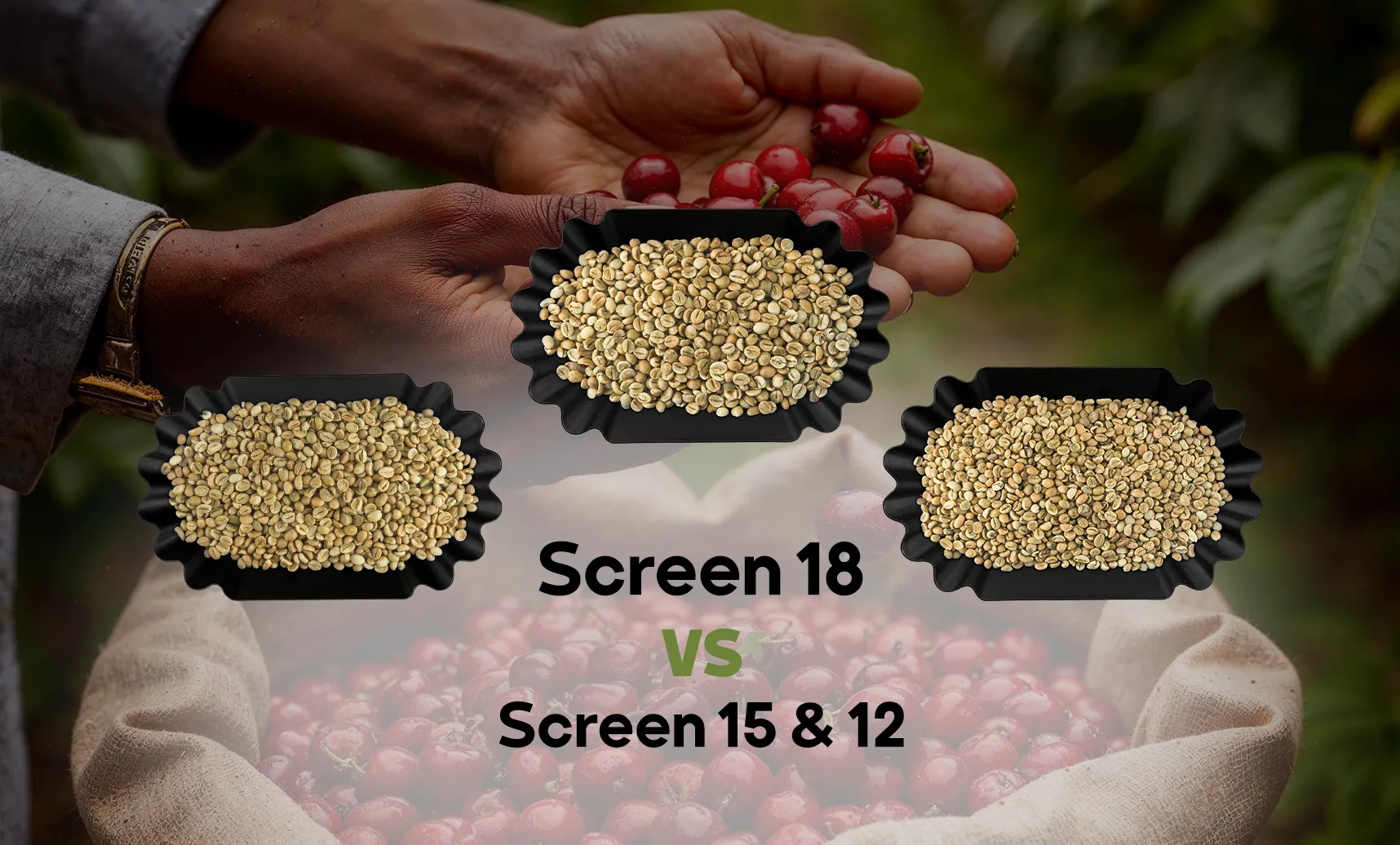
For a green coffee buyer, screen size is not a decorative grade on a specification sheet. It affects physical uniformity, sorting yield, roast consistency, commercial positioning, and often the price differential between lots. In Uganda’s Robusta trade, Screen 18, Screen 15 and Screen 12 are established size grades used in export processing and commercial quotations. The key procurement principle is simple: a larger screen does not automatically mean a better cup. Screen size should be evaluated together with defects, moisture, density, processing, crop condition, cup profile and the buyer’s intended use.
How Coffee Screen Size Is Measured
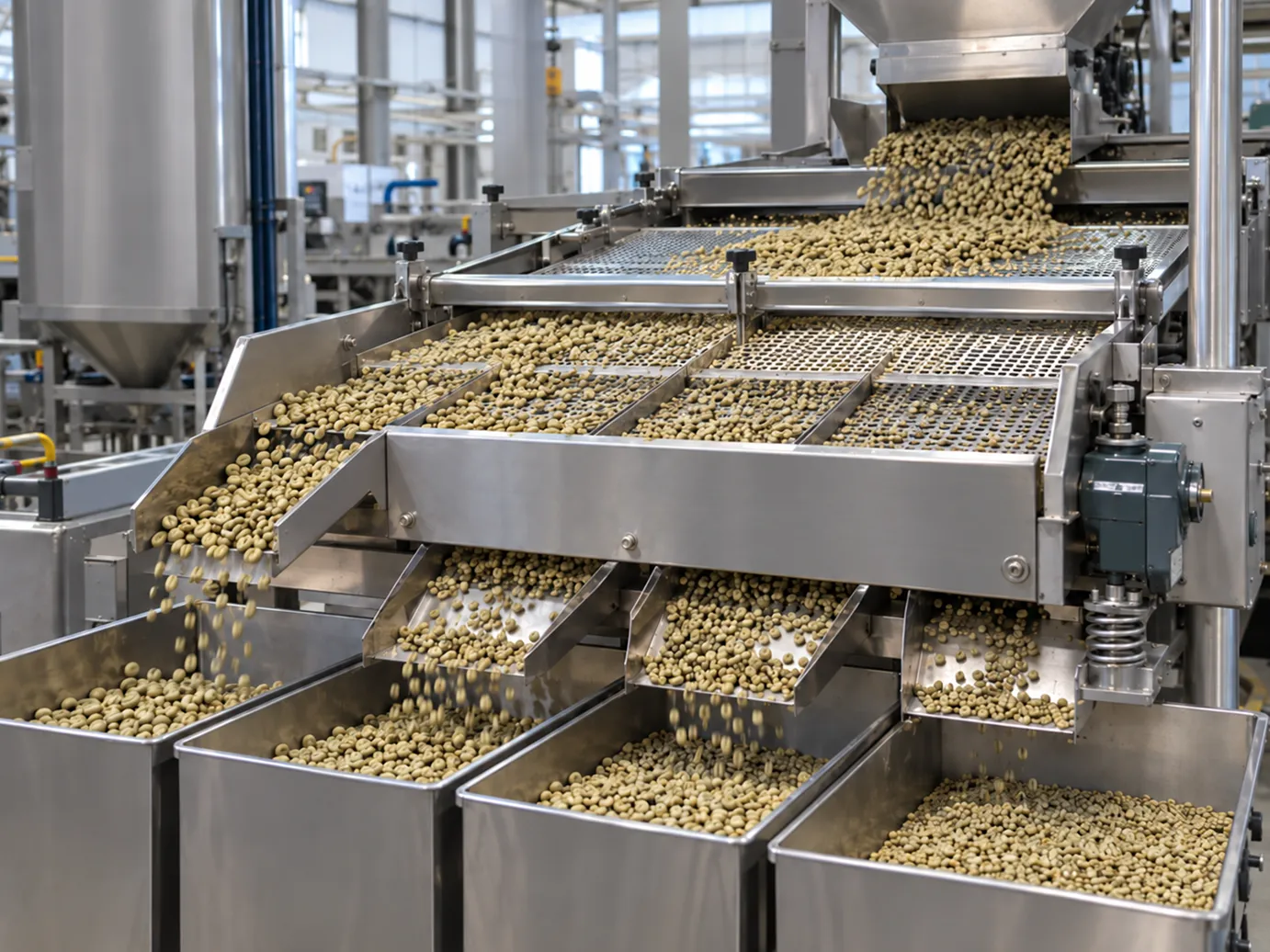
Green coffee is mechanically separated using perforated screens. The screen number corresponds to the nominal hole diameter in sixty-fourths of an inch: Screen 18 is approximately 7.14 mm, Screen 15 about 5.95 mm, and Screen 12 about 4.76 mm. Beans retained above a given screen are physically larger than beans that pass through it. In secondary processing, this sizing step helps exporters produce lots with a more controlled bean-size distribution.
Uganda’s Coffee Department describes secondary processing as the stage where clean coffee is cleaned, dried when required and then graded by size using perforated screens. For buyers, the practical value of screen grading is repeatability: it creates a measurable physical specification that can be sampled, checked and written into a contract.

Screen 18: Larger Beans for Premium Commercial Requirements
Screen 18 represents the largest of the three grades in this comparison. Uganda’s published coffee export grading regulations describe Screen 1800 with 92% by weight retained on Screen 18, with limited tolerance for smaller beans. For an importer, this translates into a lot that is visually bolder and usually more uniform in physical size than broader commercial grades.
Screen 18 is most relevant where the buyer values appearance, tight size distribution and a premium physical specification. Producing a high-retention large-bean grade requires more separation from incoming FAQ coffee, so availability and price premium can vary by crop and market conditions.
Screen 15: The Commercial Balance of Size, Supply and Cost
Screen 15 sits in the middle of the comparison and is often a practical procurement benchmark for mainstream Robusta. The published Ugandan standard for Screen 1500 specifies at least 90% by weight retained on Screen 15, with defined allowances around adjacent screens. This makes it a useful option for buyers seeking a controlled physical grade without requiring the largest bean size.
For commercial roasters, Screen 15 can offer an effective balance between uniformity, availability and cost efficiency. It suits high-volume roast and blend programs where repeatability matters more than visual bean size. Screen 15 is better evaluated as a performance specification—not as a “lower quality” version of Screen 18.
Screen 12: Smaller Beans with a Defined Commercial Role
Screen 12 is a smaller-bean grade and should be assessed according to the buyer’s end use and QC limits. Uganda’s published export grading regulations describe Screen 1200 with at least 85% by weight retained on Screen 12, together with defined proportions on adjacent screens. Because it captures a smaller size fraction, it can provide a more cost-oriented route for applications where bean appearance is secondary to functional performance and landed cost.
The correct buying question is not “Is Screen 12 good or bad?” but “Does this lot meet the physical, sensory and process requirements of our product?” Buyers should check defects, moisture, foreign matter, cup cleanliness and sample-to-shipment consistency rather than use screen number as a quality shortcut.
Screen 18 vs 15 vs 12: Technical Comparison
| Factor | Screen 18 | Screen 15 | Screen 12 |
| Nominal aperture | 18/64 in ≈ 7.14 mm | 15/64 in ≈ 5.95 mm | 12/64 in ≈ 4.76 mm |
| Published Uganda retention reference | 92% on Screen 18 | ≥90% on Screen 15 | ≥85% on Screen 12 |
| Physical appearance | Largest / boldest | Medium-large | Smaller |
| Size uniformity potential | High when tightly graded | Good commercial uniformity | Application-dependent |
| Typical commercial positioning | Premium physical specification | Mainstream commercial balance | Cost-sensitive / functional applications |
| Price tendency | Often highest differential | Middle reference | Often lower differential |
Does a Larger Screen Size Mean Better Coffee?
No. Screen size measures physical bean dimensions; it does not directly measure flavor quality, cup cleanliness or defect severity. A Screen 18 lot can still underperform if it has poor drying, excessive defects, storage damage or an unsuitable cup profile. Conversely, a well-prepared Screen 15 lot can be a stronger commercial purchase if it delivers cleaner sensory performance, tighter contractual consistency and better economics.
For professional procurement, screen size should be treated as one layer of a multi-parameter quality specification. The decision should combine screen distribution with moisture, defects, foreign matter, processing method, sample approval and cup evaluation.
How Screen Size Affects Roasting and Industrial Processing
A narrow size distribution removes one source of variability during roasting. Beans with broadly different physical dimensions can absorb and transfer heat differently, so separating lots into tighter size bands can help a roaster manage batch repeatability. However, screen uniformity does not eliminate variation caused by density, moisture or internal bean structure. Those parameters still need to be considered during profiling and production QC.
For large-scale buyers, the operational benefit is predictability. If an approved sample has a defined retention profile, the shipment should preserve that distribution within the agreed tolerance—especially when multiple containers feed the same roast or blend recipe.
Screen Size and Green Coffee Pricing
Screen grade can influence price because it changes the usable yield from a larger unsorted coffee volume. A higher Screen 18 retention requirement generally demands more selective grading, while Screen 15 and Screen 12 capture different fractions of the same physical distribution. Uganda’s Coffee Department currently publishes separate market indications for Screen 18, Screen 15 and Screen 12, illustrating that screen-size differentials are commercially recognized but variable. Buyers should therefore request the differential for the specific crop, shipment window and specification rather than assume a permanent fixed premium.
How Importers Should Specify Screen Size in a Purchase Contract
A robust B2B contract should define more than the words “Screen 18” or “Screen 15.” The measurable acceptance criteria should be explicit.
- Screen retention percentages and tolerance on adjacent screens.
- Maximum defect allowance and the defect-counting method used.
- Moisture specification and the agreed measurement method.
- Maximum foreign matter / extraneous matter.
- Processing method, crop or shipment period, and origin description.
- Pre-shipment sample approval and the permitted variation from the approved sample.
- Packaging, net weight, inspection protocol and claims procedure.
This converts screen size from a marketing label into a verifiable procurement specification—the approach that best protects both importer and exporter.
Choosing Between Screen 18, 15 and 12 for Your Business
Choose Screen 18 when large-bean appearance, tight physical uniformity or a premium commercial presentation is important. Choose Screen 15 when the priority is a balanced combination of consistency, supply flexibility and cost. Consider Screen 12 when the product can accept a smaller bean grade and the economics justify it—provided the lot still meets your sensory and physical QC requirements.
The strongest sourcing strategy is to buy to an agreed specification and approved sample, not to a screen number in isolation. For Uganda Robusta, screen grades are useful because they create a clear physical language between exporter and importer; their real value appears when that language is combined with disciplined quality control.
Ugandan Robusta: Using Screen Size as a Procurement Tool
Uganda’s Coffee Department continues to list Screen 18, Screen 15 and Screen 12 as distinct Robusta market grades. For international buyers, screen size is therefore a practical starting point for RFQs, sample evaluation and shipment QC. The next step is to connect the screen grade to the exact commercial outcome you need: roast behavior, blend role, cup target, defect tolerance and landed-cost objective.
Conclusion: Buy to Specification, Not Screen Number Alone
Screen 18, 15 and 12 describe meaningful differences in physical bean size, and those differences can affect sorting, visual uniformity, roasting consistency and commercial price positioning. But screen size is not a universal quality score. The right grade depends on the product, QC system, roast process and economics.
For importers comparing Ugandan Robusta offers, the process is to define retention tolerances, defects, moisture and cup expectations, approve a representative sample, and then verify shipment conformity against that specification.
FAQ
-
Is Screen 18 always better than Screen 15?
No. Screen 18 is physically larger, but cup quality and commercial suitability depend on defects, moisture, processing, density, storage and sensory performance. A clean, consistent Screen 15 lot can be the better purchase for a specific roast or blend.
-
What screen size is most suitable for commercial Robusta roasting?
There is no single universal answer. Screen 15 is often a practical commercial balance, while Screen 18 may suit buyers prioritizing larger-bean uniformity and Screen 12 may suit more cost-sensitive applications. The correct choice should be validated by sample roasting and production requirements.
-
Can buyers request customized screen-size specifications from Ugandan exporters?
Yes, subject to lot availability and processing capability. Buyers should define the required retention percentages, tolerances and other QC parameters in the RFQ or contract and confirm them against an approved pre-shipment sample.